Premium Ceramic Crucibles | High-Performance Lab & Industrial Solutions


PRODUCT PARAMETERS
Description
Overview of Mullite Crucible
Mullite crucibles are made from a high-performance ceramic material composed primarily of alumina (Al₂O₃) and silica (SiO₂). Known for their excellent thermal stability and mechanical strength, mullite crucibles are widely used in high-temperature applications such as melting metals, glass, and ceramics. They offer superior resistance to thermal shock and chemical attack, making them indispensable in both laboratory and industrial settings.
Features of Mullite Crucible
Thermal Shock Resistance: Exceptional ability to withstand rapid temperature changes without cracking.
High Mechanical Strength: Strong and durable, even at elevated temperatures.
Chemical Stability: Resistant to most chemicals, ensuring minimal contamination during processes.
Temperature Range: Can operate effectively at temperatures up to 1650°C.
Low Thermal Expansion: Minimal expansion or contraction with temperature changes, ensuring dimensional stability.
Non-Reactive: Does not react with the materials being processed, preserving sample purity.
Versatility: Suitable for a wide range of applications including metallurgy, glass manufacturing, and laboratory experiments.

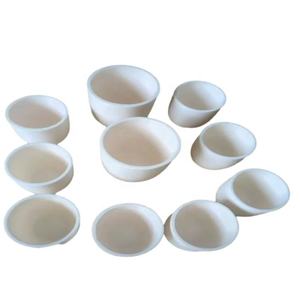
(31.28% Al2O3 64.83% SiO2 mullite cordierite ceramic crucible)
Specifications of 31.28% Al2O3 64.83% SiO2 mullite cordierite ceramic crucible
This ceramic crucible contains 31.28% aluminum oxide (Al2O3) and 64.83% silicon dioxide (SiO2). It combines mullite and cordierite for balanced performance. The mix ensures high thermal stability and low thermal expansion. It handles extreme temperatures up to 1350°C without cracking. The material resists sudden temperature changes. This makes it suitable for repeated heating and cooling cycles.
The crucible works well in industrial furnaces and lab environments. It melts metals, alloys, and glass materials efficiently. The structure remains stable under prolonged heat exposure. It resists chemical corrosion from acids, alkalis, and molten salts. This extends its lifespan in harsh conditions.
Mechanical strength is a key feature. The dense ceramic structure prevents breakage during handling. It supports heavy loads without deforming. The smooth inner surface minimizes material sticking. Cleaning is straightforward after use.
Production uses high-purity raw materials. Sintering at controlled temperatures ensures uniformity. The process creates a fine-grained microstructure. This enhances durability and thermal performance.
Standard sizes range from 10 ml to 5000 ml capacity. Custom shapes and dimensions are available. The crucible fits most standard furnace setups. It works with electric, gas, and induction heating systems.
Users should avoid rapid cooling. Gradual temperature changes prevent stress damage. Direct contact with flames is not recommended. Use protective trays or supports during heating. Proper handling maintains performance over time.
Quality checks include thermal shock tests and density measurements. Each batch undergoes X-ray fluorescence analysis. This confirms chemical composition accuracy. Leak-proof designs ensure safe containment of molten materials.
The crucible serves metallurgy, chemistry, and materials science applications. It is reusable with careful maintenance. Cost-effectiveness comes from long-term reliability. Storage requires a dry environment. Moisture exposure before use should be avoided.
This product meets ASTM and ISO standards for ceramic labware. Technical support is available for custom requirements.

(31.28% Al2O3 64.83% SiO2 mullite cordierite ceramic crucible)
Applications of 31.28% Al2O3 64.83% SiO2 mullite cordierite ceramic crucible
This ceramic crucible contains 31.28% aluminum oxide (Al2O3) and 64.83% silicon dioxide (SiO2). It combines mullite and cordierite phases. The mix improves performance in high-temperature settings. The material resists thermal shock well. It handles sudden temperature changes without cracking. This makes it reliable for repeated heating and cooling cycles. The crucible works in environments up to 1300°C. It keeps strength under extreme heat.
The low thermal expansion of the material matters. It reduces stress during rapid heating. This prevents warping or breaking. The chemical stability is strong. It resists reactions with acids, alkalis, and molten metals. This suits harsh industrial processes. The crucible lasts longer than standard ceramic options. It cuts replacement costs over time.
Applications include metal melting. Foundries use it for casting alloys like gold, silver, and aluminum. Labs apply it for high-purity sample preparation. It prevents contamination during experiments. Glass manufacturers benefit too. The crucible withstands molten glass corrosion. It maintains shape and integrity over many uses.
Chemical processing industries rely on it. It holds corrosive substances during reactions. The inert nature keeps chemical interactions minimal. Jewelry makers prefer it for lost-wax casting. It handles precise temperature control without degrading.
The structure includes fine-grained alumina-silica matrix. This boosts mechanical strength. It resists abrasion from stirring or scraping. Users find it easy to clean. Slag and residue do not stick easily. Maintenance stays simple.
The crucible suits electric and gas furnaces. It performs well in oxidizing or reducing atmospheres. Users save energy. The thermal efficiency lowers fuel costs. Small-scale workshops and large factories both adopt it.
Custom shapes and sizes are available. Options include tall form, low form, or wide basins. This matches specific process needs. The product meets ASTM standards for refractory materials. Quality checks ensure consistency.
Cost-effectiveness comes from durability. It outperforms graphite or clay crucibles in lifespan. Users reduce downtime for replacements. Safety improves due to reliable heat resistance. Workers handle high-temperature tasks with less risk.
The crucible serves aerospace, automotive, and research sectors. It melts advanced materials like superalloys or composites. It supports precise thermal treatments. Performance remains stable across batches.
Recycling is possible after use. The material does not release toxins when discarded. This aligns with eco-friendly industrial practices.
Company Introduction
Welcome to Teen-Hot,a leading global supplier of high-quality crucibles designed for various industrial applications. We offer an extensive range of crucibles, including graphite, ceramic, and metal varieties, tailored to meet the needs of foundries, laboratories, and manufacturers. Our products are renowned for their durability, thermal resistance, and precision engineering, ensuring optimal performance in melting and heat treatment processes. With advanced manufacturing facilities and a commitment to excellence, we provide reliable, cost-effective solutions worldwide. Partner with us for your crucible needs and experience superior quality, expert support, and timely delivery.
If you have any questions, please feel free to contact us(nanotrun@yahoo.com).
Payment Methods
T/T, Western Union, Paypal, Credit Card etc.
Shipment Methods
By air, by sea, by express, as customers request.
5 FAQs of 31.28% Al2O3 64.83% SiO2 mullite cordierite ceramic crucible
What is the main material composition of this ceramic crucible? The crucible contains 31.28% aluminum oxide (Al2O3) and 64.83% silicon dioxide (SiO2). These form mullite and cordierite phases. The combination improves thermal stability. The remaining percentage includes trace additives for strength. This mix ensures resistance to extreme heat and chemical corrosion.
What temperature can this crucible withstand? The crucible handles continuous use up to 1600°C (2912°F). Short-term exposure to 1650°C (3002°F) is possible. Sudden temperature changes might cause cracks. Gradual heating and cooling are recommended. The structure resists thermal shock better than standard ceramics due to its phase composition.
What applications suit this crucible? It works for melting metals like gold, silver, and platinum. Labs use it for high-temperature chemical reactions. Industrial furnaces employ it for glass processing or alloy production. It serves in heat treatment processes. The low thermal expansion prevents deformation during repeated heating cycles.
How do I maintain this crucible? Avoid mechanical impacts during handling. Clean residues after each use with non-abrasive tools. Do not quench hot crucibles in water. Store in dry conditions to prevent moisture absorption. Check for surface cracks before reuse. Replace if deep cracks or warping appear.
Can this crucible be customized for specific needs? Yes. Manufacturers adjust dimensions and wall thickness based on requirements. Special shapes accommodate unique furnace designs. Some users request pre-fired versions for immediate high-temperature use. Surface treatments like glazing are optional for easier cleaning. Bulk orders often include tailored packaging. Contact suppliers directly for custom specifications.

(31.28% Al2O3 64.83% SiO2 mullite cordierite ceramic crucible)
REQUEST A QUOTE
RELATED PRODUCTS

High Purity Graphite Crucible Mould Vessels For Gold Precious Mental Melting Shaping

Customizable High Temperature Al2o3 Alumina Ceramic Crucible

ODM OEM High-Temperature Ceramic Crucible Aluminum Oxide Metal Melting Rod Features Silver Jewelry Punching Cutting Welding Pump
1500-1800C High Temperature 99 Al2o3 Alumina Ceramic crucible Cup For Melting Gold
heat resistance corundum mullite ceramic crucible
