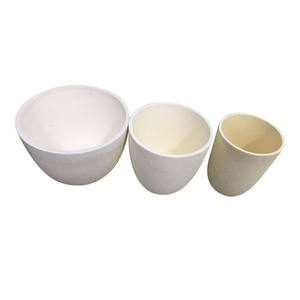
Premium Ceramic Crucibles | High-Performance Lab & Industrial Solutions


PRODUCT PARAMETERS
Description
Overview of Mullite Crucible
Mullite crucibles are made from a high-performance ceramic material composed primarily of alumina (Al₂O₃) and silica (SiO₂). Known for their excellent thermal stability and mechanical strength, mullite crucibles are widely used in high-temperature applications such as melting metals, glass, and ceramics. They offer superior resistance to thermal shock and chemical attack, making them indispensable in both laboratory and industrial settings.
Features of Mullite Crucible
Thermal Shock Resistance: Exceptional ability to withstand rapid temperature changes without cracking.
High Mechanical Strength: Strong and durable, even at elevated temperatures.
Chemical Stability: Resistant to most chemicals, ensuring minimal contamination during processes.
Temperature Range: Can operate effectively at temperatures up to 1650°C.
Low Thermal Expansion: Minimal expansion or contraction with temperature changes, ensuring dimensional stability.
Non-Reactive: Does not react with the materials being processed, preserving sample purity.
Versatility: Suitable for a wide range of applications including metallurgy, glass manufacturing, and laboratory experiments.

(High Temperature Resistant Alumina Ceramic Crucible)
Specifications of High Temperature Resistant Alumina Ceramic Crucible
Alumina ceramic crucibles handle intense heat well. They’re made from pure alumina powder. This material gets fired at super high temperatures. It becomes very dense and strong. These crucibles can take temperatures up to 1650 degrees Celsius. Some special grades manage even higher, around 1750 degrees Celsius. They are tough. They resist chemical attack from many acids and bases. This makes them safe for melting various materials.
The crucibles come in many sizes. Common capacities range from 5 milliliters to 5000 milliliters. You can find different shapes too. Standard shapes include tall form, low form, and conical types. Custom shapes are also possible. The wall thickness is important. It affects how well the crucible handles heat changes. Typical walls are between 3 millimeters and 10 millimeters thick. Thicker walls offer more strength. Thinner walls heat up faster.
Thermal shock resistance is a key feature. These crucibles won’t crack easily when heated or cooled quickly. This is vital for furnace work. They heat up and cool down without breaking. The alumina material stays stable. It doesn’t warp or change size much under heat. This stability means precise results. The smooth surface inside the crucible helps too. Materials don’t stick much. Cleaning is easier later.
These crucibles work in many industries. Labs use them for testing and melting. Metallurgy uses them for precious metals. They are common in research and development. They also work in jewelry making. Their high temperature limit is crucial. It allows work with metals like gold, platinum, and silver. They are reliable tools for demanding heat applications.

(High Temperature Resistant Alumina Ceramic Crucible)
Applications of High Temperature Resistant Alumina Ceramic Crucible
High temperature resistant alumina ceramic crucibles are essential tools in many demanding settings. These crucibles handle extreme heat without breaking down. They are made from alumina, a very tough ceramic material. This material is excellent for high heat applications because it resists thermal shock. Thermal shock happens when materials heat up or cool down too fast. Alumina crucibles withstand those sudden changes well. They also resist chemical attack. Many harsh chemicals won’t damage them. This makes them safe for melting metals or processing reactive substances.
Laboratories rely heavily on these crucibles. Scientists use them for heating samples to very high temperatures. They are common in chemistry labs for melting materials. They are also used in materials science research. Researchers study new compounds or test existing ones under intense heat. The crucibles provide a stable, inert container for these experiments. Industry uses them too. Metal foundries employ alumina crucibles for melting precious metals like gold and platinum. These metals require very high melting points. Alumina crucibles can take the heat.
The glass industry also benefits. Workers use these crucibles to melt glass batches or hold molten glass. They are good for processing ceramic powders before firing. Electronics manufacturing uses them too. They are involved in producing semiconductors or other delicate components needing high purity. The crucibles don’t introduce contaminants. They are inert. They also last a long time. Their durability means fewer replacements are needed. This saves money over time. Alumina crucibles come in various sizes. Users can find small ones for lab tests or large ones for industrial production. Choosing the right size depends on the specific job.
Company Introduction
Welcome to Teen-Hot,a leading global supplier of high-quality crucibles designed for various industrial applications. We offer an extensive range of crucibles, including graphite, ceramic, and metal varieties, tailored to meet the needs of foundries, laboratories, and manufacturers. Our products are renowned for their durability, thermal resistance, and precision engineering, ensuring optimal performance in melting and heat treatment processes. With advanced manufacturing facilities and a commitment to excellence, we provide reliable, cost-effective solutions worldwide. Partner with us for your crucible needs and experience superior quality, expert support, and timely delivery.
If you have any questions, please feel free to contact us(nanotrun@yahoo.com).
Payment Methods
T/T, Western Union, Paypal, Credit Card etc.
Shipment Methods
By air, by sea, by express, as customers request.
5 FAQs of High Temperature Resistant Alumina Ceramic Crucible
Here are 5 FAQs about High Temperature Resistant Alumina Ceramic Crucibles:
What makes alumina ceramic crucibles good for high heat?
Alumina ceramic crucibles handle very high temperatures. Alumina is the main material. It has a high melting point itself. This lets the crucible survive intense heat without breaking. It keeps its shape well.
How hot can these crucibles get?
They can withstand extremely high temperatures. Many standard alumina crucibles are fine up to about 1700°C. Some special grades go even higher. You must check the specific type you have. Always follow the maker’s temperature limits.
Are they strong against chemicals?
Yes, they are chemically stable. Alumina resists attack from many acids and bases. It handles harsh chemicals well. This makes them good for melting various materials. They won’t easily corrode or react.
Can I use them over and over?
Yes, they are reusable. Alumina crucibles are very durable. They resist thermal shock pretty well. This means heating and cooling cycles won’t break them easily. Handle them carefully though. Avoid sudden big temperature changes.
What are they mostly used for?
People use them for high-heat applications. Melting metals is common. So is melting glass. Labs use them for analyzing samples. They are good for growing crystals too. Any job needing a tough, heat-proof container suits them.

(High Temperature Resistant Alumina Ceramic Crucible)
REQUEST A QUOTE
RELATED PRODUCTS

Professional cordierite mullite ceramic sagger crucible and saggar for sintering

30ml Durable High Alumina Ceramic Crucible For Lab 99% High Purity Alumina Ceramic Component Al2O3 Crucible

Gold melting crucible for high temperature resistant alumina ceramic crucibles
Factory Laboratory Metal Smelting Aluminum oxide Alumina High Form Ceramic Crucible
500g 1kg 2kg 3kg High Purity & High Density Graphite Melting Crucible Pot to load the melting metals