Premium Ceramic Crucibles | High-Performance Lab & Industrial Solutions

Key takeaways
- A BN ceramic crucible for brazing and soldering is a boron nitride based vessel used to contain filler metal or solder inside a controlled-atmosphere furnace or chamber.
- Boron nitride is selected for its low wettability by many molten metals and its thermal shock resistance, but these properties depend on the specific grade and filler alloy.
- The controlled atmosphere reduces oxidation but does not replace the crucible or eliminate the need for process cleanliness.
- Selection should consider filler compatibility, maximum use temperature, thermal shock resistance, machinability, and cycle life.
- Brazing and soldering differ mainly in temperature, which affects atmosphere requirements and crucible demands.
- Practical limits include mechanical handling, chemical compatibility with the filler, and inspection-based replacement criteria.
What Is a BN Ceramic Crucible for Brazing and Soldering Under Controlled Atmosphere?
A BN ceramic crucible for brazing and soldering under controlled atmosphere is a boron nitride (BN) based refractory vessel that holds filler metals, flux-free brazing alloys, or solder charges while the joining process runs inside a furnace or chamber with a managed gas environment. In this definition, the object is the crucible, the condition is a controlled atmosphere such as inert gas, reducing gas, or vacuum, and the intended result is that the molten filler or solder stays chemically stable and does not adhere to the crucible wall.
The term 'controlled atmosphere' means the oxygen and moisture content around the crucible is deliberately limited or replaced. Brazing and soldering both rely on wetting of the parent metal by a molten filler. If oxygen is present, oxide films can form on the filler or the workpieces and interfere with wetting. A BN crucible is chosen because boron nitride is chemically inert toward many molten metals and does not behave like a conventional oxide ceramic that may react with or be wetted by the melt.
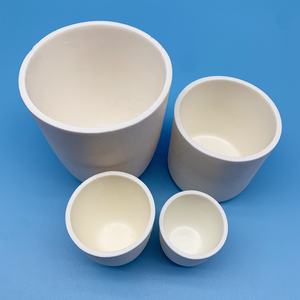
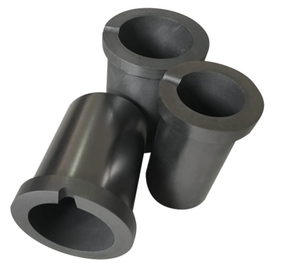
BN ceramic crucibles are commonly produced in two broad forms: hot-pressed BN, which is dense and machinable, and composite BN grades that combine boron nitride with other ceramic phases to adjust strength, thermal shock resistance, or machinability. The crucible may be a simple cup, a shallow dish, a tube, or a custom-shaped liner. The correct form depends on whether the filler is supplied as a preform, paste, wire, foil, or powder, and on how the furnace loads the parts.
This definition is deliberately narrow. A BN crucible for brazing and soldering is not the same as a general-purpose refractory crucible for melting bulk metal, and it is not automatically suitable for every alloy or every temperature. Its role is to contain a relatively small amount of filler or solder, to resist thermal cycling, and to release the melt cleanly when the process is complete. Whether a specific grade is appropriate depends on the alloy chemistry, the peak temperature, the atmosphere composition, and the required number of cycles.
| Aspect | Explanation |
|---|---|
| Object | A boron nitride based refractory vessel that holds filler metal or solder during joining |
| Condition | Used inside a furnace or chamber with a controlled atmosphere such as inert gas, reducing gas, or vacuum |
| Purpose | Contain the molten filler, limit contamination, and resist adhesion to the crucible wall |
| Material basis | Boron nitride provides low wettability by many molten metals and good thermal shock resistance |
| Typical forms | Cup, dish, tube, or custom liner, depending on filler form and furnace loading |
| Key selection factors | Filler alloy compatibility, maximum use temperature, thermal shock resistance, machinability, and cycle life |
| Not implied | Universal non-wetting, flux elimination, or a fixed number of reuse cycles |
Why Boron Nitride Is Used in Brazing and Soldering Crucibles
Boron nitride is a synthetic ceramic with a layered crystal structure. That structure gives it two properties that matter in brazing and soldering: low wettability by many molten metals and good thermal shock resistance compared with some dense oxide ceramics. When a molten filler does not wet the crucible surface, the filler tends to remain as a discrete charge or droplet rather than spreading and bonding to the crucible wall. This makes it easier to separate the joined assembly from the crucible after cooling.
The controlled atmosphere reinforces this behavior. In an inert or reducing environment, the filler surface is less likely to develop an oxide skin that would change its flow characteristics. The crucible itself is not a getter or a purifier; it does not remove oxygen from the furnace. Its contribution is to avoid introducing contamination and to tolerate the thermal profile of the joining cycle without reacting with the filler.
BN also has relatively low thermal expansion and can withstand rapid heating and cooling better than some brittle ceramics. In practice, this means a BN crucible may survive repeated brazing cycles where a more thermal-shock-sensitive material would crack. However, boron nitride is not unbreakable. Mechanical handling, clamping forces, and uneven heating can still damage it, and the actual limit depends on the grade and geometry.
It is important to separate the material's general reputation from a specific supplier's data. Statements such as 'excellent non-wetting' or 'high thermal shock resistance' are meaningful only when tied to a grade, a temperature range, and a filler alloy. Without that context, they are qualitative descriptions rather than guarantees. A user should treat them as selection criteria to verify, not as universal facts.
How the Controlled Atmosphere Affects Crucible Performance
The atmosphere is not a background detail; it changes what the crucible must tolerate. In vacuum brazing, the absence of gas reduces convective heat transfer and can affect how the filler melts and flows. In inert gas brazing, typically argon or nitrogen, the gas composition and flow rate influence temperature uniformity and the removal of volatiles. In reducing atmospheres, such as hydrogen-bearing gas mixtures, the environment can help reduce certain oxides but also introduces safety and material-compatibility considerations.
For a BN crucible, the key atmosphere-related questions are whether the gas reacts with boron nitride at the process temperature and whether trace moisture or oxygen will attack the crucible or the filler. Boron nitride is generally considered stable in inert and many reducing atmospheres, but it can be sensitive to certain conditions, and the safe operating window depends on the specific grade. This is why atmosphere specification and crucible specification should be reviewed together rather than separately.
The atmosphere also affects how the crucible is loaded and unloaded. In a vacuum furnace, the crucible may be heated primarily by radiation, so its position relative to the heating elements matters. In a gas atmosphere, convection can create temperature gradients that influence where the filler melts first. A crucible that performs well in one furnace configuration may behave differently in another, even at the same nominal temperature.
Finally, the atmosphere determines what kind of contamination is possible. A controlled atmosphere reduces oxidation, but it does not eliminate all sources of contamination. Binders in brazing pastes, residual machining oils, and outgassing from fixtures can all deposit material on the crucible or the workpieces. The crucible's role is to be a stable container, not a filter, so process cleanliness remains a separate requirement.
Key Properties to Evaluate Before Selecting a BN Crucible
When comparing BN crucibles for brazing and soldering, the first property to check is compatibility with the filler alloy. Different filler families, such as silver-based, copper-based, aluminum-based, or nickel-based brazing alloys, have different melting ranges and different tendencies to react with ceramics. A grade that is suitable for one family may not be suitable for another. The relevant question is not 'is BN non-wetting?' but 'is this BN grade non-wetting toward this filler at this temperature?'
The second property is maximum use temperature. Boron nitride grades differ in how they behave as temperature rises. Some are intended for continuous service at moderate temperatures, while others are designed for higher-temperature excursions. The peak temperature of the brazing or soldering cycle, plus any overshoot, should be compared against the grade's stated limit. Exceeding that limit can lead to degradation, dimensional change, or loss of non-wetting behavior.
The third property is thermal shock resistance. Brazing and soldering cycles often involve rapid heating and cooling. A crucible that cracks during the first cycle is not useful regardless of its other properties. Geometry matters here: thin walls and simple shapes generally tolerate thermal shock better than thick, complex shapes. The way the crucible is supported in the furnace also affects stress distribution.
The fourth property is machinability and dimensional tolerance. BN is often selected because it can be machined into custom shapes, such as a liner that matches a specific workpiece contour. If the crucible must fit precisely around a joint or a preform, the achievable tolerance and surface finish become selection criteria. A rough surface may hold residue, while an overly polished surface may be unnecessary for the application.
The fifth property is cycle life and cleaning. Some users need a crucible that can be reused many times; others treat it as a consumable. Reusability depends on how the filler behaves, how the crucible is cleaned, and whether the atmosphere introduces deposits. A crucible that is easy to clean and inspect will generally have a longer practical service life than one that traps residue.
Brazing Versus Soldering: What Changes for the Crucible
Brazing and soldering are both joining processes that use a molten filler metal, but they differ mainly in temperature. Brazing typically occurs above the melting point of the filler but below the melting point of the parent metals, often at higher temperatures than soldering. Soldering occurs at lower temperatures. For a BN crucible, the practical consequence is that brazing places greater demands on thermal stability and atmosphere control, while soldering places greater emphasis on avoiding contamination and preserving filler chemistry at lower temperatures.
In brazing, the filler may be a preform, a paste, or a wire. The crucible may need to hold the preform in position or contain a powder that melts and flows into the joint. In soldering, the filler is often a lower-melting alloy, and the crucible may be used to hold a solder charge or to protect the joint from the atmosphere. The same BN crucible can sometimes serve both processes, but the grade and geometry should be matched to the higher-temperature application if the crucible will be used for both.
Atmosphere requirements also differ. Brazing in vacuum or high-purity inert gas is common because higher temperatures make oxidation more likely. Soldering may tolerate a wider range of atmospheres, including nitrogen or mildly reducing environments, but the crucible still needs to avoid introducing contaminants. A crucible that is suitable for vacuum brazing may not be the best choice for a soldering process that uses a flux, because flux residues can interact with the crucible surface.
The distinction matters for selection because a crucible optimized for one process may be over-specified or under-specified for the other. Over-specifying can increase cost without benefit; under-specifying can lead to premature failure or contamination. The correct approach is to define the process window first, then select the crucible grade and shape that fits it.
Operating Conditions and Practical Limits
A BN crucible for brazing and soldering operates within a set of conditions that should be defined before use. These include the peak temperature and dwell time, the heating and cooling rates, the atmosphere composition and pressure, the filler alloy and its form, and the number of intended cycles. Each condition interacts with the others. For example, a fast heating rate may be acceptable in one atmosphere but not in another, and a filler that is non-wetting at one temperature may behave differently at a higher temperature.
Mechanical limits are also important. Boron nitride is not a high-strength structural material in the same way as some metals or dense ceramics. It can chip or crack if dropped, over-tightened, or subjected to uneven pressure. The crucible should be supported evenly and handled with care. If the crucible is used as a liner inside a metal fixture, the fixture should not constrain thermal expansion in a way that creates stress.
Chemical limits depend on the filler and the atmosphere. Some molten alloys may react with boron nitride over time, especially at higher temperatures or with longer contact. The safe approach is to test the specific combination under representative conditions before committing to production. A small-scale trial can reveal whether the filler wets the crucible, whether residue builds up, and whether the crucible survives the thermal cycle.
Finally, there is the question of inspection and replacement. A BN crucible should be inspected for cracks, chipping, discoloration, and residue buildup. A damaged crucible may still hold the filler, but it may also shed particles or change the thermal profile. Establishing a replacement criterion based on visual inspection and process results is more reliable than assuming a fixed number of cycles.
Common Misunderstandings About BN Crucibles
One common misunderstanding is that boron nitride is universally non-wetting. In reality, non-wetting depends on the filler alloy, the temperature, the atmosphere, and the surface condition of the crucible. A BN crucible that releases a silver-based filler cleanly may behave differently with an aluminum-based filler. The material's layered structure helps, but it is not a guarantee for every melt.
Another misunderstanding is that a controlled atmosphere makes the crucible unnecessary. The atmosphere reduces oxidation, but it does not eliminate the need for a container that can hold the filler and survive the thermal cycle. The crucible and the atmosphere are complementary: the atmosphere protects the filler and workpieces, while the crucible contains the filler and limits contact with other surfaces.
A third misunderstanding is that all BN grades are interchangeable. Hot-pressed BN, composite BN, and coated BN products can differ in density, strength, thermal expansion, and maximum use temperature. A grade selected for one brazing process may not be the best choice for another. The grade designation and the supplier's data should be reviewed against the specific application.
A fourth misunderstanding is that a higher price always means better performance. The right crucible is the one that matches the process window, not the one with the highest headline property. In some cases, a simpler and less expensive grade may be entirely adequate, while in others a specialized grade is necessary. The selection should be driven by the application requirements.
FAQ: BN Ceramic Crucibles for Brazing and Soldering
Q: Can a BN crucible be used in both vacuum and inert gas atmospheres? A: Boron nitride is generally considered compatible with inert and many reducing atmospheres, and it is also used in vacuum applications. However, the safe operating window depends on the specific grade and the process temperature. The atmosphere and crucible specifications should be reviewed together.
Q: Does a BN crucible eliminate the need for flux? A: No. A controlled atmosphere can reduce the need for flux in some brazing and soldering processes, but the crucible itself does not replace flux or atmosphere control. Whether flux is needed depends on the parent metals, the filler, and the furnace environment.
Q: How many cycles can a BN crucible last? A: There is no universal number. Cycle life depends on the grade, the filler alloy, the peak temperature, the heating and cooling rates, and how the crucible is handled and cleaned. Inspection-based replacement criteria are more reliable than a fixed cycle count.
Q: Is BN suitable for all brazing filler metals? A: No. Compatibility varies with the filler alloy and the process conditions. Some fillers may react with or wet boron nitride more than others. A representative trial is the practical way to confirm suitability.
Q: What is the main advantage of BN over other crucible ceramics? A: The main advantage is the combination of non-wetting behavior toward many molten metals and good thermal shock resistance, which supports repeated brazing and soldering cycles. The actual benefit depends on the specific grade and application.
Frequently asked questions
Can a BN crucible be used in both vacuum and inert gas atmospheres?
Boron nitride is generally considered compatible with inert and many reducing atmospheres, and it is also used in vacuum applications. However, the safe operating window depends on the specific grade and the process temperature. The atmosphere and crucible specifications should be reviewed together.
Does a BN crucible eliminate the need for flux?
No. A controlled atmosphere can reduce the need for flux in some brazing and soldering processes, but the crucible itself does not replace flux or atmosphere control. Whether flux is needed depends on the parent metals, the filler, and the furnace environment.
How many cycles can a BN crucible last?
There is no universal number. Cycle life depends on the grade, the filler alloy, the peak temperature, the heating and cooling rates, and how the crucible is handled and cleaned. Inspection-based replacement criteria are more reliable than a fixed cycle count.
Is BN suitable for all brazing filler metals?
No. Compatibility varies with the filler alloy and the process conditions. Some fillers may react with or wet boron nitride more than others. A representative trial is the practical way to confirm suitability.
What is the main advantage of BN over other crucible ceramics?
The main advantage is the combination of non-wetting behavior toward many molten metals and good thermal shock resistance, which supports repeated brazing and soldering cycles. The actual benefit depends on the specific grade and application.
.
